World Cup 2026 Host Cities and Stadiums: The Complete Guide to All 16 Venues
From Estadio Azteca's opening whistle to the MetLife final — every host city, stadium and the practical stuff fans need to plan a summer across three countries.

vpnrank.io is reader-supported: we may earn a commission if you buy through links in this article. This never affects our rankings.
The 2026 World Cup is the biggest in history: 48 teams, 104 matches, and 16 host cities spread across the United States, Canada and Mexico. Play runs from 11 June to 19 July 2026, opening at Mexico City's Estadio Azteca and finishing at MetLife Stadium near New York. This guide covers every city, every stadium, and how fans can plan around them.
How the 16 cities are split across three countries
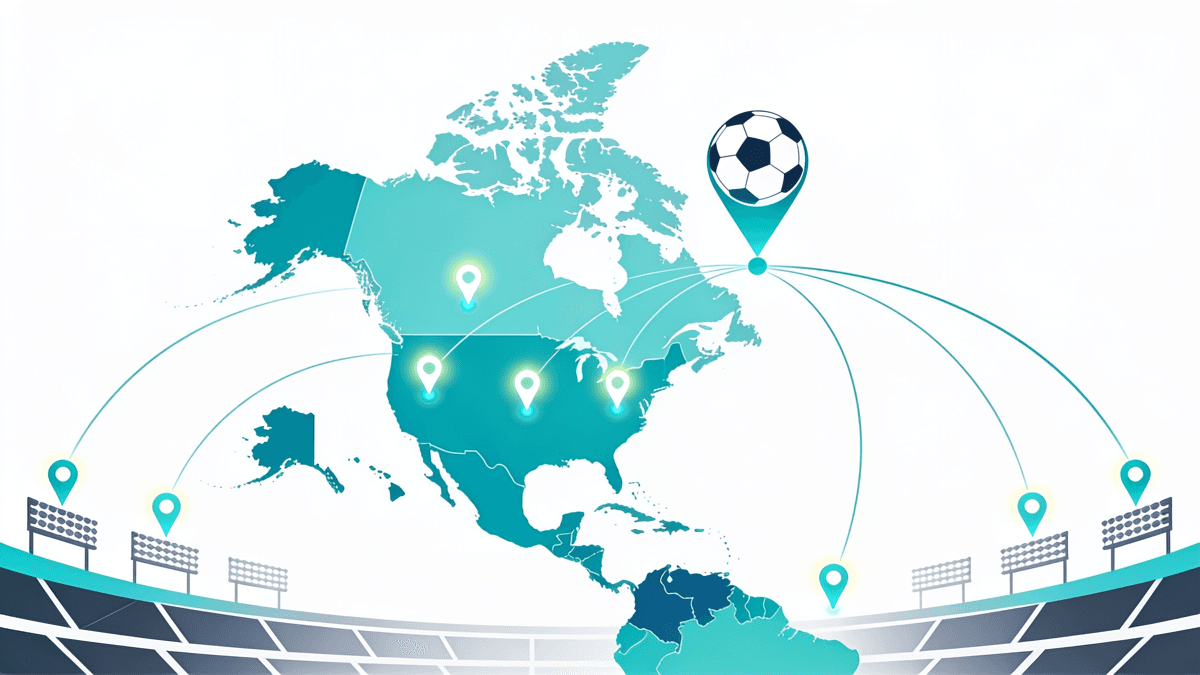
For the first time, the World Cup is co-hosted by three nations, and the geography is enormous — Miami and Vancouver sit roughly 2,800 air miles apart. Eleven host cities are in the United States, three in Mexico, and two in Canada. Understanding this split is the first step to planning any trip, because it shapes travel routes, time zones and climate.
The United States carries the bulk of the tournament, staging 78 of the 104 matches, including every game from the quarterfinals onward — both semifinals, the third-place match and the final. Mexico and Canada each host 13 matches: Mexico brings three storied cities clustered relatively close together, while Canada contributes two venues on opposite coasts. Here is the full breakdown:
- United States (11): Atlanta, Boston, Dallas, Houston, Kansas City, Los Angeles, Miami, New York/New Jersey, Philadelphia, San Francisco Bay Area and Seattle.
- Mexico (3): Mexico City, Guadalajara and Monterrey.
- Canada (2): Toronto and Vancouver.
One quirk worth noting: during the tournament every venue uses a neutral "tournament name" — MetLife Stadium becomes New York New Jersey Stadium, SoFi Stadium becomes Los Angeles Stadium, AT&T Stadium becomes Dallas Stadium, and so on. FIFA does this to avoid clashes with commercial sponsors whose deals don't include the governing body. We list both names below so you don't get confused at the turnstiles or when matching a ticket to a venue.
The other thing this split does is stretch the calendar across four time zones and three very different climates. A group-stage swing that takes in Vancouver's mild Pacific coast, Mexico City's high-altitude thin air and Houston's Gulf Coast humidity is entirely possible on paper — but it is a punishing itinerary in practice. That is why almost every seasoned traveller ends up picking a region and building around it, a theme we return to at the end.
The 11 United States stadiums
The American venues range from a Texas colossus that can be expanded past 90,000 seats to a downtown Seattle stadium you can walk to from your hotel. Several were built or renovated for the NFL, which means enormous capacities, climate control and world-class transport links. These are the marquee stadiums of the 2026 tournament, and they carry every knockout round from the quarterfinals to the final.
East Coast and Southeast
The eastern venues cluster along the densely populated Interstate 95 corridor, which makes them the easiest US group to string together by train, bus or short flight. They also hold two of the tournament's biggest prizes: the final in New Jersey and a semifinal in Atlanta. Here is what each one hosts and how it feels on the ground:
- New York New Jersey Stadium (MetLife Stadium), East Rutherford, NJ — around 82,500. Hosts the final on 19 July plus seven earlier matches, making it the tournament's centrepiece. It is served by a dedicated train spur from Secaucus Junction, though expect long post-match queues.
- Boston Stadium (Gillette Stadium), Foxborough, MA — around 65,000. A quarterfinal on 9 July, with natural grass laid over the usual artificial surface. It sits about 30 miles southwest of Boston, so plan the commuter-rail or shuttle logistics in advance.
- Philadelphia Stadium (Lincoln Financial Field), Philadelphia, PA — around 69,000. A round-of-16 match on 4 July, and one of the most walkable, transit-friendly venues thanks to the Broad Street Line subway that runs to the stadium complex.
- Atlanta Stadium (Mercedes-Benz Stadium), Atlanta, GA — around 71,000. A retractable-roof, downtown venue hosting a semifinal on 15 July, with a MARTA rail station right outside — one of the smoothest big-match arrivals in the country.
- Miami Stadium (Hard Rock Stadium), Miami Gardens, FL — around 65,000. A busy site that hosts a quarterfinal on 11 July and the third-place playoff on 18 July, under a canopy roof that shields fans from the region's frequent summer downpours.
Central and West
The central and western venues are where the distances get serious — a hop from Kansas City to Los Angeles is a genuine cross-country flight. This group is anchored by the tournament's busiest stadium in Texas and includes the newest venue in the whole competition. These are the stadiums to plan a dedicated West Coast or heartland leg around:
- Dallas Stadium (AT&T Stadium), Arlington, TX — expandable to around 94,000. The busiest venue of all, hosting nine matches — the most of any stadium — including a semifinal on 14 July, under a retractable roof. Its World Cup configuration can be expanded well beyond its usual footprint, making it the largest-capacity venue of the tournament.
- Houston Stadium (NRG Stadium), Houston, TX — around 72,000. A round-of-16 match on 4 July; the retractable roof and air conditioning are welcome relief against Gulf Coast heat and humidity that regularly sits in the 90s.
- Kansas City Stadium (Arrowhead Stadium), Kansas City, MO — around 73,000. Holder of the Guinness World Record for the loudest outdoor stadium; hosts group matches and a quarterfinal on 11 July. It is one of the few venues where you will genuinely want a car.
- Los Angeles Stadium (SoFi Stadium), Inglewood, CA — around 70,000. The newest US venue, opened in 2020, with a striking open-sided translucent canopy roof, hosting a quarterfinal on 10 July.
- San Francisco Bay Area Stadium (Levi's Stadium), Santa Clara, CA — around 68,500. Group-stage matches and a round-of-32 match on 1 July — no knockout rounds beyond that. It sits in Santa Clara, closer to San Jose than to San Francisco itself, so mind the 45-mile gap from the city.
- Seattle Stadium (Lumen Field), Seattle, WA — around 67,000. A round-of-16 match on 6 July, walkable from downtown and served by the Link light rail — one of the easiest big-city arrivals in the country.
The 3 Mexico stadiums
Mexico's trio is the most compact cluster in the tournament — the three cities sit between roughly 350 and 500 miles apart, with flights of around 90 minutes between them. This is the easiest region to string together multiple matches, and it opens the whole show with real history at Estadio Azteca. Each stadium brings a distinct character, from thin mountain air to desert heat:
- Estadio Ciudad de México (Estadio Azteca), Mexico City — around 80,800. Hosts the tournament opener on 11 June — Mexico vs South Africa — becoming the first stadium ever to host three World Cup opening matches, having also opened the 1970 and 1986 tournaments. It sits at around 7,200 feet of altitude, a genuine factor for players and travelling fans alike.
- Estadio Monterrey (Estadio BBVA), Monterrey — around 51,000. A striking modern venue framed by the Cerro de la Silla mountain and one of the warmest sites of the tournament, with temperatures that can push past 90°F. Hosts group games and a round-of-32 match on 29 June.
- Estadio Guadalajara (Estadio Akron), Guadalajara — around 46,000. A stadium opened in 2010 and set into a natural grassy bowl, hosting group-stage matches — including a Mexico fixture — in one of the country's most vibrant, tequila-and-mariachi cities.
The 2 Canada stadiums
Canada's two venues sit on opposite sides of the country, so fans following the co-hosts should expect a long, five-hour flight rather than a quick hop between them. Both are proven international grounds, and Vancouver in particular carries recent big-tournament pedigree from the 2015 Women's World Cup final that it also staged.
- Toronto Stadium (BMO Field), Toronto — expanded to around 45,000. The smallest capacity in the tournament, with permanent seats boosted by temporary stands for the event; hosts Canada's opener on 12 June plus five further matches including a round-of-32 game on 2 July. It sits on the Exhibition grounds by Lake Ontario, an easy streetcar or GO train ride from downtown.
- B.C. Place Vancouver (BC Place), Vancouver — around 52,500. A retractable-roof downtown stadium hosting group games and a round-of-16 match on 7 July, a short walk or SkyTrain ride from the city centre and waterfront.
Where the marquee matches land
If you're planning around the biggest fixtures rather than a specific team, the tournament's spine is easy to map. The opener anchors the calendar in Mexico City, and the business end of the competition concentrates entirely in the United States. Knowing these anchor dates and cities helps you decide which region to base yourself in for the crucial final fortnight:
- 1Opening match: 11 June, Estadio Azteca, Mexico City (Mexico vs South Africa).
- 2Quarterfinals: 9 July in Boston, 10 July in Los Angeles, and two on 11 July in Miami and Kansas City.
- 3Semifinals: 14 July in Dallas (AT&T Stadium) and 15 July in Atlanta (Mercedes-Benz Stadium).
- 4Third-place match: 18 July, Hard Rock Stadium, Miami.
- 5Final: 19 July, MetLife Stadium, East Rutherford, New Jersey.
Notice how tightly the closing week is packed: from the first quarterfinal on 9 July to the final on 19 July, the tournament crowns a champion in just eleven days, criss-crossing the US the whole way. For full fixture context as the bracket firms up, our regularly updated World Cup 2026 hub tracks the schedule, and our broader sports streaming guides cover how each match is broadcast in different countries.
Practical travel tips for fans on the ground
This is a continent-sized tournament played at the height of North American summer, so logistics matter as much as tickets. Matches span four time zones and wildly different climates — from Vancouver's mild coast to Houston's humidity and Mexico City's altitude. A little planning saves a lot of exhausting overnight travel and a lot of money on last-minute flights.
- Build routes around regions, not random matches. Pick a cluster — Mexico, the Eastern Seaboard, or the West Coast — and follow games there rather than crisscrossing the map. The eastern I-95 corridor and the Mexican trio are the two most efficient bases.
- Leave at least a full day between matches in different cities. Two days is more comfortable and absorbs the flight delays that are almost guaranteed at peak summer travel.
- Pack for heat and storms. Summer brings genuine heat, humidity and thunderstorms in many host cities; retractable-roof and canopy venues like Dallas, Houston, Atlanta and Miami help, fully open ones like Kansas City don't.
- Respect the altitude in Mexico City. At around 7,200 feet, the thin air affects fitness and hydration — give yourself a day to acclimatise before a match if you can.
- Mind the borders. Crossing between the US, Canada and Mexico adds time, paperwork and potential visa or ESTA requirements — factor it into any multi-country itinerary and check the rules for your passport early.
- Book internal flights and hotels well ahead. With millions of fans moving between the same handful of cities on the same handful of dates, prices spike and availability vanishes closer to kickoff.
- Sort connectivity early. A local eSIM or roaming plan that works across all three countries avoids nasty surprises when you land and need maps, tickets and transit apps immediately.
Watching matches when you're travelling — or stuck at home
Broadcast rights for the World Cup are carved up country by country, which creates a familiar headache: the service you pay for at home often goes dark the moment you cross a border, and the match you want may sit behind a broadcaster you can't access from where you're standing. This is where a lot of travelling fans get caught out, especially between the three host nations.
Say you've followed your team to Monterrey but your subscription is with a US broadcaster, or you're at home abroad and want your national commentary team rather than the local feed. A VPN lets you connect to a server back home and reach your usual streaming service, and it's the same trick that makes services like Netflix, Peacock and BBC iPlayer behave as if you never left the country. If you're unsure whether a given match is even available in your location, our can-I-watch checker is a quick sanity test before kickoff.
Want the fastest, most reliable option for streaming World Cup matches abroad? See why ExpressVPN tops our tests for sports streaming.
See our top-ranked VPNs →Speed matters more for live sport than almost anything else — buffering during a penalty shootout is its own kind of heartbreak. If you want the underlying numbers, our VPN speed tests compare providers head to head, and our full streaming VPN guide breaks down which services work with which platforms. For the commercial pick-a-provider rundown, that's the guide to read rather than this one.
The bottom line
The 2026 World Cup is a genuine continental road trip: 16 cities, three countries, and stadiums that range from historic to space-age. Plan around a region, respect the distances and the summer weather, book your internal travel early, and sort your connectivity before you fly. Do that, and the biggest World Cup ever becomes one of the great sporting holidays too.
Frequently asked questions
How many host cities are there for the 2026 World Cup?
There are 16 host cities across three countries: 11 in the United States, three in Mexico, and two in Canada. Together they will stage 104 matches between 11 June and 19 July 2026 — the first 48-team World Cup and the first hosted jointly by three nations.
Which stadium hosts the 2026 World Cup final?
The final is at MetLife Stadium in East Rutherford, New Jersey — operating under the neutral name New York New Jersey Stadium during the tournament. It seats around 82,500 and hosts the championship match on 19 July 2026, along with seven earlier fixtures across the group and knockout stages.
Where is the opening match of the 2026 World Cup?
The opening match is at Estadio Azteca in Mexico City (tournament name: Estadio Ciudad de México) on 11 June 2026, with Mexico facing South Africa. It becomes the first stadium in history to host three World Cup opening matches, having also opened the 1970 and 1986 tournaments.
Which 2026 World Cup stadium is the largest?
Dallas Stadium (AT&T Stadium in Arlington, Texas) is the largest, with a World Cup configuration that can be expanded to around 94,000. It also hosts the most matches of any single venue, nine in total, including a semifinal on 14 July, and has a retractable roof to manage the Texas summer heat.
How hard is it to travel between World Cup 2026 host cities?
It varies hugely. Mexico's three cities are only 350 to 500 miles apart with 90-minute flights, but coast-to-coast US or cross-border trips can eat an entire day. Fans are advised to base themselves in one region, leave at least a full day between matches in different cities, and plan for four time zones.
Can I stream World Cup 2026 matches while travelling between countries?
Broadcast rights differ by country, so your home streaming service may not work once you cross a border between the three hosts. Many fans use a VPN to connect to a server in their home country and access their usual broadcaster and commentary. Choose a fast provider, since live sport is especially sensitive to buffering.
The best VPNs of 2026, ranked
Now you know how — here are the VPNs we recommend, independently tested and ranked for speed, streaming, privacy and value. Any of them works for everything in this guide.

ExpressVPN Ultra fast & secure. Great for privacy, downloads, and everyday browsing on all your devices. 24/7 live chat support.
ExpressVPN Ultra fast & secure. Great for privacy, downloads, and everyday browsing on all your devices. 24/7 live chat support.

IPVanish Fast speeds with unlimited device connections. Strong no-logs privacy and 24/7 live chat support. Great for families.

IPVanish Fast speeds with unlimited device connections. Strong no-logs privacy and 24/7 live chat support. Great for families.

NordVPN Excellent speeds with one of the largest server networks. Strong security features and easy-to-use apps. 24/7 live chat support.
NordVPN Excellent speeds with one of the largest server networks. Strong security features and easy-to-use apps. 24/7 live chat support.

Proton VPN Swiss-based VPN with strong privacy focus. Audited no-logs policy and open-source apps. Great for privacy-conscious users.
Proton VPN Swiss-based VPN with strong privacy focus. Audited no-logs policy and open-source apps. Great for privacy-conscious users.

CyberGhost Fast speeds and strong privacy tools. Simple apps, automatic WiFi protection, and 24/7 live chat support.
CyberGhost Fast speeds and strong privacy tools. Simple apps, automatic WiFi protection, and 24/7 live chat support.

TotalVPN Affordable VPN with strong privacy and reliable speeds. Easy-to-use apps for all major devices. No-logs policy.
TotalVPN Affordable VPN with strong privacy and reliable speeds. Easy-to-use apps for all major devices. No-logs policy.

Private Internet Access High-speed VPN with a large server network and advanced security settings. Ad blocker included and 24/7 live chat support.
Private Internet Access High-speed VPN with a large server network and advanced security settings. Ad blocker included and 24/7 live chat support.

Surfshark Unlimited device connections at a budget-friendly price. Includes ad blocker and strong privacy tools. Great value for money.
Surfshark Unlimited device connections at a budget-friendly price. Includes ad blocker and strong privacy tools. Great value for money.
Rankings are based on our independent testing methodology. We evaluate speed, privacy, security features, and value for money. We may earn affiliate commissions from links on this page, which helps fund our testing — this does not influence our rankings.