
The Best VPNs Right Now
Prices verified 30 August 2026- Fast & secure servers in USA, UK, Canada & over 100 more countries
- Change IP address location for greater Internet privacy, security & freedom
- Access your favorite websites, apps & services safely from anywhere
- Enjoy the latest seasonal promotions, trials & 100% refund guarantees*


ExpressVPN Ultra fast & secure. Great for privacy, downloads, and everyday browsing on all your devices. 24/7 live chat support.
ExpressVPN Ultra fast & secure. Great for privacy, downloads, and everyday browsing on all your devices. 24/7 live chat support.

IPVanish Fast speeds with unlimited device connections. Strong no-logs privacy and 24/7 live chat support. Great for families.

IPVanish Fast speeds with unlimited device connections. Strong no-logs privacy and 24/7 live chat support. Great for families.

NordVPN Excellent speeds with one of the largest server networks. Strong security features and easy-to-use apps. 24/7 live chat support.
NordVPN Excellent speeds with one of the largest server networks. Strong security features and easy-to-use apps. 24/7 live chat support.
Proton VPN Swiss-based VPN with strong privacy focus. Audited no-logs policy and open-source apps. Great for privacy-conscious users.
Proton VPN Swiss-based VPN with strong privacy focus. Audited no-logs policy and open-source apps. Great for privacy-conscious users.

CyberGhost Fast speeds and strong privacy tools. Simple apps, automatic WiFi protection, and 24/7 live chat support.
CyberGhost Fast speeds and strong privacy tools. Simple apps, automatic WiFi protection, and 24/7 live chat support.

TotalVPN Affordable VPN with strong privacy and reliable speeds. Easy-to-use apps for all major devices. No-logs policy.
TotalVPN Affordable VPN with strong privacy and reliable speeds. Easy-to-use apps for all major devices. No-logs policy.

Private Internet Access High-speed VPN with a large server network and advanced security settings. Ad blocker included and 24/7 live chat support.
Private Internet Access High-speed VPN with a large server network and advanced security settings. Ad blocker included and 24/7 live chat support.

Surfshark Unlimited device connections at a budget-friendly price. Includes ad blocker and strong privacy tools. Great value for money.
Surfshark Unlimited device connections at a budget-friendly price. Includes ad blocker and strong privacy tools. Great value for money.
Rankings are based on our independent testing methodology. We evaluate speed, privacy, security features, and value for money. We may earn affiliate commissions from links on this page, which helps fund our testing — this does not influence our rankings.
2026 Rankings At a Glance
| # | VPN | Score | Price (2-yr plan) | Money-back | Key strength |
|---|---|---|---|---|---|
| 1 | ExpressVPN | 9.9/10 | $2.79/mo | 30 days | 3,000+ servers in 105 countries |
| 2 | IPVanish | 9.8/10 | $2.19/mo | 30 days | 3,200+ servers in 112+ countries |
| 3 | NordVPN | 9.7/10 | $3.09/mo | 30 days | 7,400+ servers in 118 countries |
| 4 | Proton VPN | 9.6/10 | $2.99/mo | 30 days | 15,000+ servers in 120+ countries |
| 5 | CyberGhost | 9.5/10 | $2.03/mo | 45 days | Servers in 100 countries |
| 6 | TotalVPN | 9.4/10 | $1.59/mo | 30 days | Servers in 50+ countries |
| 7 | Private Internet Access | 9.3/10 | $1.75/mo | 30 days | Servers in 91 countries |
| 8 | Surfshark | 9.2/10 | $1.78/mo | 30 days | 3,200+ servers in 100 countries |
Scores follow our testing methodology. Prices reflect the current 2-year promotional rate, billed upfront.
Measured Download Speeds
Rankings are easy to assert and hard to check, so here is the raw measurement behind the speed component of every score on this page. Each provider was connected from the same 1 Gbps wired line in US East on its recommended WireGuard-family protocol, and the figure below is the average of repeated runs at different times of day. The spread between the fastest and slowest VPN we track is 63 Mbps — about 6 percentage points of your line speed, which is the honest size of the difference a VPN choice makes on a fast connection.
Long-haul spot checks
A nearby server is the best case. These are the same measurements repeated from other regions, for the providers we re-test in each one. Baselines differ because the local line speed differs, so compare the percentage column rather than the raw Mbps — and note that the last three routes exit through national filtering, which is where the raw numbers fall away and obfuscated connections earn their keep.
| Region | Line baseline | VPN | Download | % of line |
|---|---|---|---|---|
| Tokyo, JapanLocal fiber (Nuro Hikari), Tokyo servers | 1000 Mbps | ExpressVPN | 455 Mbps | 46% |
| NordVPN | 447 Mbps | 45% | ||
| Surfshark | 396 Mbps | 40% | ||
| London, UKLondon servers from a UK fiber line | 1000 Mbps | ExpressVPN | 441 Mbps | 44% |
| NordVPN | 433 Mbps | 43% | ||
| Surfshark | 405 Mbps | 41% | ||
| Madrid, SpainMadrid servers from Spanish fiber | 500 Mbps | NordVPN | 415 Mbps | 83% |
| ExpressVPN | 395 Mbps | 79% | ||
| Surfshark | 372 Mbps | 74% | ||
| Dubai, UAEUK/EU exits through Etisalat DPI (obfuscated) | 500 Mbps | ExpressVPN | 312 Mbps | 62% |
| NordVPN | 305 Mbps | 61% | ||
| Surfshark | 280 Mbps | 56% | ||
| Shanghai, ChinaHong Kong / Tokyo exits through the Great Firewall (obfuscated) | 200 Mbps | ExpressVPN | 130 Mbps | 65% |
| NordVPN | 125 Mbps | 63% | ||
| Tehran, IranIstanbul / EU exits through national filtering (obfuscated) | 50 Mbps | ExpressVPN | 32 Mbps | 64% |
| NordVPN | 28 Mbps | 56% |
6 of the 15 regions in our dataset — the full table, including every route we measure, is on the VPN speed-test page. Providers not listed for a region are benchmarked on the US East line only. Method: how we test.
What Each VPN Costs When It Renews
Every per-month price quoted on this page — and on every other VPN comparison site — is a first-term introductory rate, billed up front for two or three years. What you pay after that term is a different number, and providers print it in small type next to the offer. Our price tracker opens each provider's checkout every day, so we can simply show you both figures side by side.
The step up is not uniform. On the plans below, IPVanish renews at 3.4× its intro rate while Private Internet Access renews at 1.1× — because its renewal keeps the same multi-year term rather than dropping to an annual one. The length of the renewal term, not the headline discount, is what decides the real cost of year three.
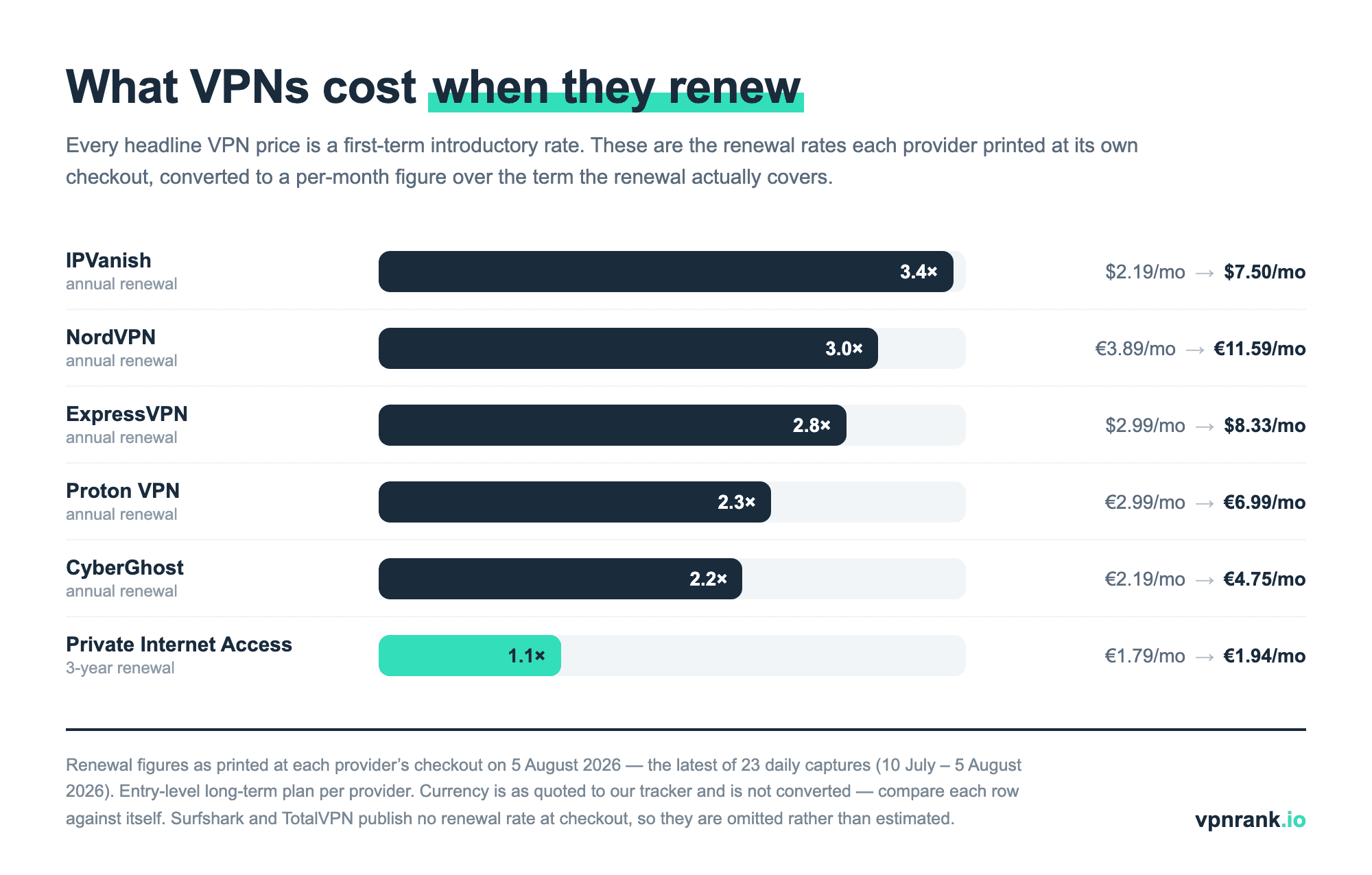
| VPN | Intro rate | Then renews at | Renewal per month |
|---|---|---|---|
| ExpressVPN | €2.49/moBasic, 2 years + 4 months | €79.95 / year | €6.66/mo (2.7×) |
| IPVanish | $2.19/moEssential, 2-year plan | $89.99 / year | $7.50/mo (3.4×) |
| NordVPN | €3.89/moBasic, 2-year plan | €139.08 / year | €11.59/mo (3.0×) |
| Proton VPN | €3.49/moVPN Plus, 2-year plan | €83.88 / year | €6.99/mo (2.0×) |
| CyberGhost | €2.19/mo2 years + 2 months | €56.94 / year | €4.75/mo (2.2×) |
| Private Internet Access | €1.79/mo3 years + 3 months | €70 / 3 years | €1.94/mo (1.1×) |
| Surfshark | €2.49/moStarter, 27 months | not stated at checkout | — |
Captured at each provider's own checkout on August 10, 2026 for the entry-level long-term plan; higher tiers renew higher. These are the live checkout quotes our tracker sees, so they can differ from the advertised US list prices in the ranking table above — plan lengths, regional storefronts and promotions all move independently. Currency is whatever the provider quoted our tracker — figures are not converted, so compare each row against itself rather than across rows. Renewal per month divides the renewal charge by the months it covers. Providers that do not print a renewal rate at checkout are shown as such rather than estimated. ExpressVPN's checkout switched from $ to € quotes on August 10, 2026, so its figure is not comparable with our earlier captures of the same plan. Verified August 2026.
24
daily checkout captures between July 10, 2026 and August 10, 2026
4
of these renewal rates never moved across the window (IPVanish, NordVPN, Proton VPN, Private Internet Access)
1
price rise caught in the same window — CyberGhost on July 21, 2026, €41.34 → €56.94
None of this is a reason to avoid a long-term plan — it is a reason to put the renewal date in your calendar. Every provider here refunds inside its money-back window, and the practical defence is to compare the renewal quote against the current intro offers before it bills. The full method, the market-wide price band and the renewal explainer live on the VPN Price Index, and the raw daily data is public: download our pricing dataset (JSON).
The Trade-Offs Behind Each Ranking
A ranking is only useful if it tells you what you are giving up. The scores above are close together — close enough that the deciding factor is usually a specific limitation rather than a decimal place. These are the drawbacks recorded in our full reviews, listed here so you can rule a provider out before you click through rather than after.
| VPN | Main drawbacks |
|---|---|
| ExpressVPN#1 |
|
| IPVanish#2 |
|
| NordVPN#3 |
|
| Proton VPN#4 |
|
| CyberGhost#5 |
|
| TotalVPN#6 |
|
| Private Internet Access#7 |
|
| Surfshark#8 |
|
Drawbacks are quoted from our individual VPN reviews, each of which lists the full set alongside the strengths. Scoring weights are documented in our testing methodology.
Our Top Choice
ExpressVPN Ultra fast & secure. Great for privacy, downloads, and everyday browsing on all your devices. 24/7 live chat support.
ExpressVPN Ultra fast & secure. Great for privacy, downloads, and everyday browsing on all your devices. 24/7 live chat support.
Free Privacy Tools
Built by our team and free to use — no signup, everything runs in your browser. The same checks we run when we test VPNs.

What Is My IP?
See your public IP address, location and ISP — exactly what every website you visit can see.
Check your IP →
VPN Leak Test
Check whether your browser is leaking your real IP address through WebRTC — even with a VPN on.
Run the leak test →
VPN Price Index
Live 2-year plan prices for every VPN we rank, re-verified by our price tracker every day.
See live prices →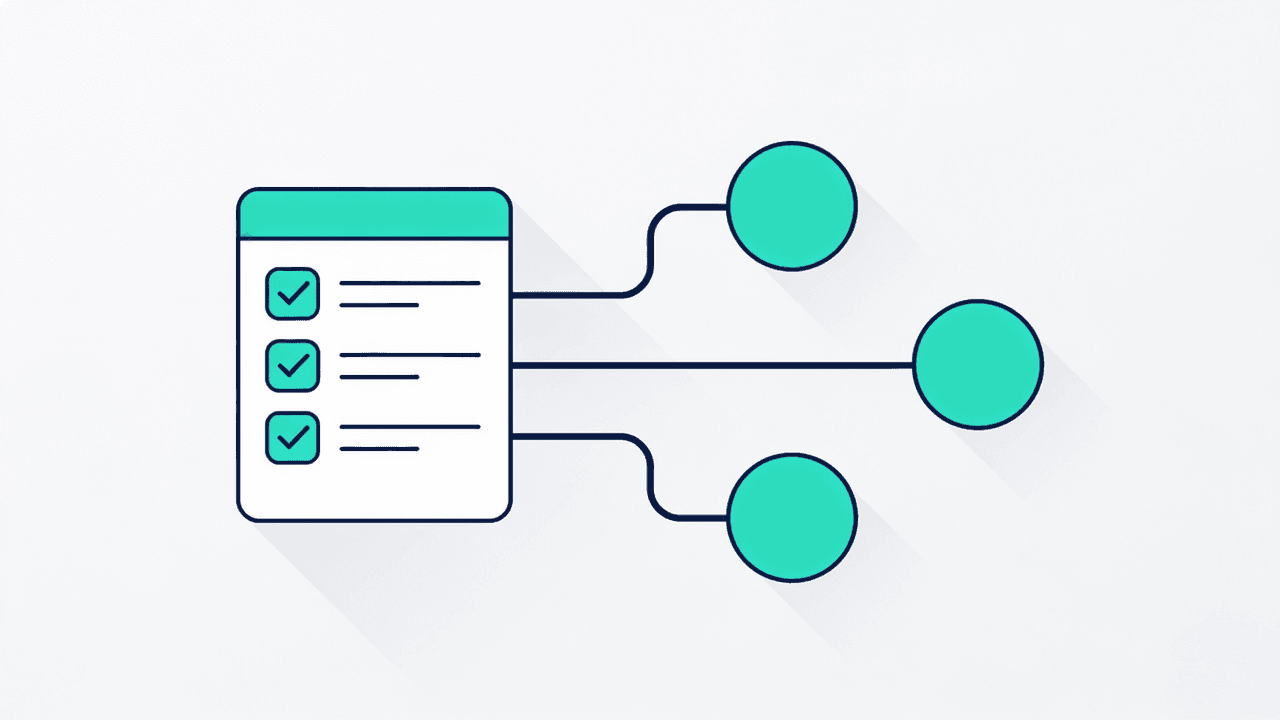
Which VPN Quiz
Answer a few quick questions about how you use the internet and get a personal recommendation.
Take the quiz →More utilities — password tools, kill switch test, IP lookup — on the full tools page.
How We Test VPNs
Our VPN comparison is built on hands-on testing, not marketing claims. We evaluate every VPN service across four critical categories using a weighted scoring system, re-running all tests monthly to ensure our rankings reflect real-world performance. Here is exactly how we arrive at our scores.
Speed & Performance (25%)
We run over 500 speed tests per VPN across servers in 30+ countries, measuring download, upload, and latency on both WireGuard and OpenVPN protocols. The fastest VPNs on our list retain over 85% of base connection speed, with top performers exceeding 700 Mbps.
Privacy & Security (30%)
We verify no-logs policies by reviewing independent audit reports from firms like PwC, Deloitte, and KPMG. Every VPN is tested for DNS, WebRTC, and IPv6 leaks. We also analyze jurisdiction, encryption standards, kill switch reliability, and corporate ownership transparency.
Streaming Performance (25%)
We measure sustained stream quality, buffering rates, and connection stability during long viewing sessions on the major streaming services. We confirm that HD and 4K playback holds steady under load and that the VPN does not introduce latency that degrades video quality.
Value for Money (20%)
We compare pricing across all plan lengths, evaluate the number of simultaneous connections, check money-back guarantee terms, and assess bundled features like ad blockers and malware protection. A cheap VPN that compromises on security will never rank highly in our review.
Our methodology is designed to reward VPN providers that deliver on their promises. We publish our testing dates so you can see exactly how current our data is. Read our full testing methodology.
Tested and scored by Martín Rossi, Editor-in-Chief & Lead VPN Tester.
What Is a VPN?
A VPN (Virtual Private Network) creates an encrypted tunnel between your device and the internet. When you connect to a VPN server, your real IP address is hidden and replaced with the server's address. All data traveling through this tunnel is encrypted using military-grade AES-256 encryption, making it unreadable to anyone who intercepts it — including your ISP, hackers, and government surveillance programs.
In practical terms, a VPN does three things: it protects your privacy by hiding your browsing activity, it secures your data on untrusted networks like public WiFi, and it shields your connection from ISP monitoring and throttling. With the global VPN market projected to reach $137 billion by 2030, these tools have become an essential part of everyday digital life.
How a VPN Works in 3 Steps
Connect
Open the VPN app and choose a server location. Most top VPNs offer one-click connection with servers in 100+ countries.
Encrypt
Your traffic is encrypted with AES-256 and routed through a secure tunnel using protocols like WireGuard or OpenVPN.
Browse Privately
Your IP address is masked and your activity is invisible to your ISP, advertisers, and potential eavesdroppers.
Why Do You Need a VPN in 2026?
Online threats are escalating faster than ever. Data breaches exposed billions of records in the past year alone, ISPs routinely sell browsing data to advertisers, and government surveillance programs continue to expand. Here are the most compelling reasons to use a VPN today, backed by real data.
Protect Your Privacy
80% of VPN users cite increased security as their primary reason for subscribing. Your ISP can see every website you visit and sell that data to third parties. A VPN encrypts your traffic so no one can track your online activity.
Stay Safe on Public WiFi
51% of VPN users say public WiFi protection is their #1 reason for using a VPN. Coffee shops, airports, and hotel networks are prime targets for man-in-the-middle attacks. A VPN makes your connection secure even on open networks.
Stream Privately Without Throttling
Many ISPs slow down video traffic during peak hours, dropping quality from 4K to 720p. A VPN encrypts your connection so your ISP cannot identify and throttle streaming traffic, keeping HD and 4K playback smooth while keeping your viewing habits private.
Work Securely From Anywhere
22% of VPN users need secure access for remote work. With 69% of VPN usage now on mobile devices, protecting your connection on the go is more important than ever for professionals, digital nomads, and business travelers.
How to Choose the Best VPN
With dozens of VPN providers on the market, finding the right one can feel overwhelming. Our VPN comparison process focuses on the factors that matter most to real users. Here is what to look for when choosing a VPN service.
Speed & Performance
The fastest VPN services using WireGuard retain 85%+ of your base speed. Look for VPNs that exceed 700 Mbps in independent tests. Slow VPNs cause buffering during streaming and lag during gaming.
Privacy & No-Logs Policy
The best VPN for privacy will have an independently audited no-logs policy verified by firms like PwC or Deloitte. Jurisdiction matters too — providers based in Panama or Switzerland are outside major surveillance alliances.
Pricing & Value
Top VPNs range from $1.59 to $6.67/month on long-term plans. The cheapest VPN is not always the best deal — factor in simultaneous connections, bundled features, and the length of the money-back guarantee (30-45 days is standard). See our live VPN price index for current pricing.
Streaming & Server Network
If streaming is your priority, look for VPNs that maintain fast, stable connections during long viewing sessions. A large server network (3,000+ servers in 100+ countries) typically means less congestion, better performance, and a nearby server for the lowest latency.
Device Compatibility
Check how many simultaneous connections are included. Surfshark offers unlimited device connections, while NordVPN and ExpressVPN allow 10 each. Look for apps on all your platforms including mobile, desktop, and smart TV.
Customer Support
24/7 live chat support is the industry standard among premium VPNs. This matters more than you think — VPN connection issues can arise with streaming services, and fast support makes the difference between frustration and resolution.
VPN Protocols Explained
A VPN protocol determines how your data is encrypted and transmitted. The protocol you use directly affects speed, security, and stability. Here are the three most important protocols you will encounter in any VPN review.
WireGuard
WireGuard is the fastest VPN protocol available today, with only about 4,000 lines of code compared to OpenVPN's 600,000+. This simplicity translates to faster speeds (700+ Mbps possible), lower battery drain on mobile devices, and a smaller attack surface for security audits. Most top VPNs now use WireGuard as their default protocol.
Used by: Surfshark (native), NordVPN (NordLynx wrapper), and most modern VPN providers
OpenVPN
OpenVPN has been the industry standard for over a decade. It is open-source, extensively audited, and supports AES-256 encryption. While slower than WireGuard, OpenVPN is highly configurable and runs on virtually any platform. It is the best choice when you need maximum compatibility or want to run a VPN on older hardware.
Best for: Maximum compatibility, advanced configurations, and router-level VPN setups
IKEv2/IPSec
IKEv2 excels at quickly re-establishing connections after network interruptions, making it ideal for mobile users who switch between WiFi and cellular data frequently. It offers strong security with AES-256 encryption and is natively supported on iOS, making it a popular mobile VPN protocol.
Best for: Mobile devices, users who frequently switch networks, and iOS users
Some providers offer proprietary protocols built on WireGuard: NordVPN's NordLynx and ExpressVPN's Lightway. These add features like double NAT for extra privacy while maintaining WireGuard-level speeds.
Free VPNs vs Paid VPNs
Free VPNs are tempting, but they come with serious trade-offs. Research has shown that many free VPN apps contain malware, sell user data to advertisers, or inject tracking cookies into your browsing sessions. If the product is free, you are often the product.
Free VPN Limitations
- Data caps (typically 500 MB - 10 GB per month)
- Limited server locations (3-5 countries)
- Slower speeds due to overcrowded servers
- May log and sell your browsing data to third parties
- Slow speeds make HD streaming buffer constantly
Paid VPN Advantages
- Unlimited bandwidth and 3,000-9,000+ servers
- Servers in 100+ countries for global access
- Independently audited no-logs policies
- Fast, stable speeds for HD and 4K streaming
- 24/7 live chat support and 30-day money-back guarantees
The bottom line: Paid VPNs start from just $1.59/month on long-term plans — less than the price of a coffee. Every VPN in our comparison includes a 30-day money-back guarantee, so you can test the service completely risk-free before committing.
Explore Our VPN Guides
Beyond our overall rankings, we test and score the best VPN for every use case, device, and category. Browse the guides below to find the right VPN for your specific needs.
By Use Case
By Device
Frequently Asked Questions
Are VPNs legal?
Yes, VPNs are completely legal in most countries including the US, UK, Canada, Australia, and across the EU. Some countries like China, Russia, and the UAE have restrictions on VPN use, but even there, hundreds of millions of people use VPNs daily — the UAE alone has 65-84% VPN adoption. Using a VPN for privacy, security, and accessing content is a legitimate practice worldwide.
Will a VPN slow down my internet?
Modern VPNs using the WireGuard protocol typically retain 85-90% of your original connection speed. In our tests, the fastest VPN services achieved over 700 Mbps — more than enough for 4K streaming, online gaming, and video calls. The days of VPNs causing noticeable slowdowns are largely over with current protocol technology.
What is the best VPN for streaming?
Based on our testing, NordVPN and ExpressVPN deliver the most consistent streaming performance with the fastest speeds for HD and 4K playback. Both maintain stable connections under heavy load and prevent ISP throttling that can degrade stream quality. ExpressVPN scored 9.8/10 in our streaming tests, while NordVPN scored 9.6/10. Surfshark is also a strong option at a lower price point.
What is the best VPN for privacy?
The best VPN for privacy will have an independently audited no-logs policy, strong encryption, and be based in a privacy-friendly jurisdiction. NordVPN (Panama, audited by PwC and Deloitte) and ExpressVPN (BVI, audited by KPMG) top our privacy rankings. Both use RAM-only server technology, meaning no data survives a server reboot.
Can a VPN be hacked?
While no technology is 100% immune, breaking AES-256 encryption used by top VPNs would take billions of years with current computing power. The real risks are weak protocols, DNS leaks, and unreliable kill switches — which is why we test every VPN for these vulnerabilities. VPNs that use RAM-only servers and have passed independent security audits offer the strongest protection available.
Will a VPN improve my streaming experience?
A premium VPN encrypts your connection so your ISP cannot identify and throttle video traffic, which often results in smoother HD and 4K playback during peak hours. It also keeps your viewing private from network operators and protects your account credentials on public WiFi. We test streaming performance every month and update our rankings accordingly.
How much does a VPN cost?
VPN prices vary widely depending on the plan length. Monthly plans cost $9.99-$15.45, but long-term plans offer significant savings. On 2-year plans, the best VPNs cost $1.59-$3.09/month. TotalVPN is the cheapest at $1.59/month, Surfshark is $1.78/month, ExpressVPN is $2.79/month and NordVPN is $3.09/month. All providers in our VPN comparison offer 30-day money-back guarantees.
How many devices can I use with a VPN?
It depends on the provider. Surfshark offers unlimited simultaneous connections, making it ideal for families and households with many devices. NordVPN and ExpressVPN allow 10 devices each. Most people find that 10 connections are more than enough to cover phones, laptops, tablets, and smart TVs.
How does VPNRank make money?
We earn affiliate commissions when you purchase a VPN through our links. This funds our independent testing infrastructure and keeps the site free for you. Our rankings are based entirely on our testing methodology — we never allow affiliate commissions to influence our scores or VPN review outcomes. We believe transparency is the foundation of trust.
Is it worth paying for a VPN in 2026?
Absolutely. With the global VPN market exceeding $105 billion in 2026, VPNs have become an essential privacy tool. For less than $2/month, you get encrypted internet access, faster streaming free from ISP throttling, public WiFi protection, and peace of mind. Given that ISPs can legally sell your browsing data and data breaches continue to rise, the cost of a VPN is minimal compared to the cost of compromised personal data.