World Cup 2026: Dates, Groups, Host Cities & How to Watch Every Match
The first 48-team, 104-match World Cup is here — spread across the USA, Canada and Mexico. Here is the complete fan's guide to dates, format, venues and where to stream every game.

vpnrank.io is reader-supported: we may earn a commission if you buy through links in this article. This never affects our rankings.
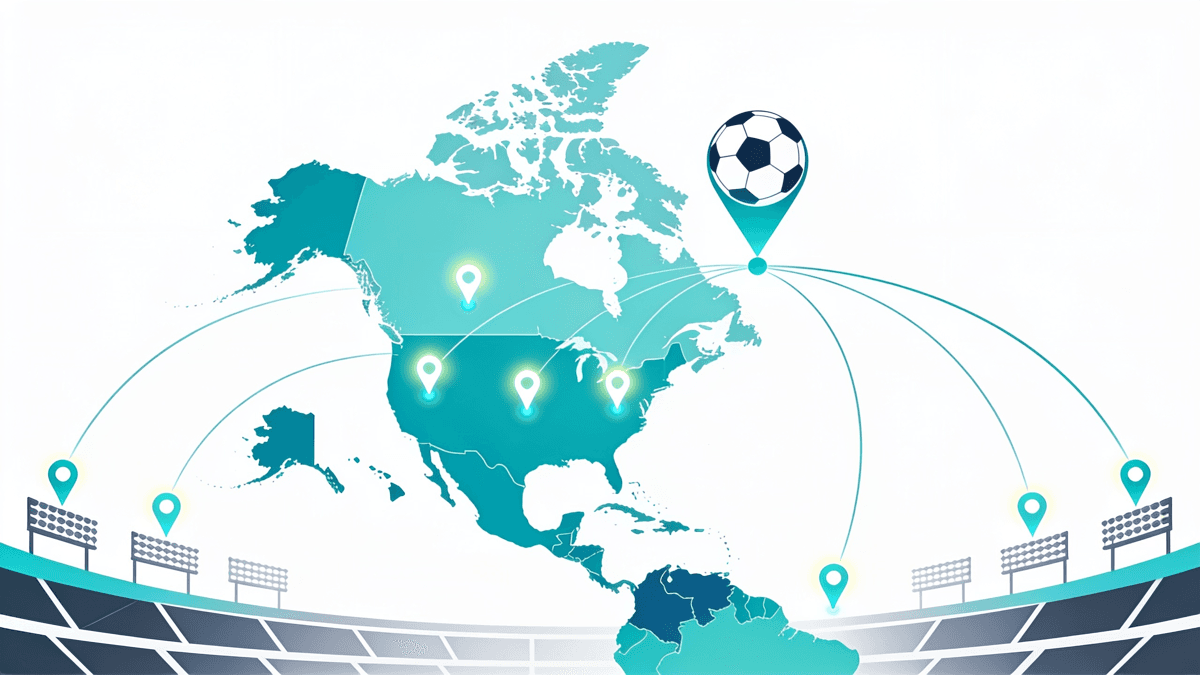
The 2026 FIFA World Cup runs from 11 June to 19 July 2026 across the United States, Canada and Mexico. It is the first 48-team, 104-match World Cup, played in 16 host cities. Mexico City's Estadio Azteca staged the opening game; the final is at MetLife Stadium near New York on 19 July.
World Cup 2026 at a glance
This is the biggest World Cup ever staged and the first hosted by three countries. The headline numbers are worth committing to memory: 48 teams, 104 matches, 16 cities and 39 days of football. Before we dig into the detail, here is the essential outline every fan needs.
- Dates: 11 June to 19 July 2026 (39 days)
- Hosts: United States (11 cities), Mexico (3 cities), Canada (2 cities)
- Format: 48 teams in 12 groups of four, expanded to a 104-match tournament
- Opening match: Mexico v South Africa at Estadio Azteca, Mexico City
- Final: MetLife Stadium, East Rutherford, New Jersey, on 19 July 2026
- Third-place playoff: Hard Rock Stadium, Miami, on 18 July 2026
It is also the first World Cup since the format jumped from 32 teams to 48 — a change that reshapes the group stage, adds a brand-new knockout round, and means there is meaningful football on almost every day of the tournament. Where the 2022 edition in Qatar squeezed 64 matches into a single country, 2026 stretches 104 across a continent, so the rhythm and the geography both feel different. We break down exactly how that works below.
When is the World Cup 2026? Key dates and schedule
The tournament spans 39 days, longer than the 32-day editions of 2014 and 2018. The group stage fills the first two and a half weeks, then the knockout rounds run continuously to the final. Each stage has its own window, which makes planning your viewing — or your trip — far simpler.
- Group stage: 11–27 June 2026 (72 matches across 12 groups)
- Round of 32: 28 June – 3 July 2026
- Round of 16: 4–7 July 2026
- Quarter-finals: 9–11 July 2026
- Semi-finals: 14–15 July 2026
- Third-place match: 18 July 2026 (Miami)
- Final: 19 July 2026 (New York/New Jersey)
With 72 group games packed into just over a fortnight, the opening rounds deliver a near-constant stream of football — frequently four or more matches a day, often running in overlapping blocks. That density eases once the field narrows, but the knockout phase compensates with stakes: from the Round of 32 onward, every fixture is win-or-go-home, and the bracket tightens quickly toward the closing week in July.
Because matches are spread across four North American time zones — from Eastern to Pacific, plus Mexico's zones — kick-off times vary widely, with most games slotted into afternoon and evening windows local to each host city. For European viewers that means a steady run of late-afternoon and prime-time evening games; for fans in Asia and Oceania, many fixtures land in the early morning. We cover how to keep up wherever you are in the streaming section.
The new 48-team format explained
The defining change of World Cup 2026 is the expansion to 48 teams, up from 32. They are drawn into 12 groups of four, producing 72 group-stage games. The route to the trophy is longer too: a team reaching the semi-finals now plays eight matches instead of seven, and an entirely new knockout round has been added.
Crucially, each side still plays only three group matches, so the expansion lengthens the tournament without overloading individual squads in the opening phase. What changes is the maths of survival — with the top two from every group plus a clutch of third-placed sides going through, more nations stay in contention deeper into the group stage, and the final round of group fixtures becomes a genuine scramble for the qualifying spots.
How teams qualify from the group stage
From each group of four, the top two teams advance automatically. That accounts for 24 of the 32 knockout places. The remaining eight spots go to the best third-placed teams across all 12 groups — ranked by points, then goal difference and goals scored — meaning a strong third-place finish can still keep a nation alive.
- 1Winners and runners-up of all 12 groups advance — that is 24 teams.
- 2The eight best third-placed teams (out of 12) also advance.
- 3The four weakest third-placed teams are eliminated.
- 4All 32 qualifiers then enter a single-elimination bracket.
That third-place mechanism is the format's most consequential wrinkle. Because only four of the twelve third-placed sides go home, a single point or one well-timed goal can be the difference between a flight back and a place in the last 32 — which keeps even apparently struggling teams mathematically alive until the very last group games are played.
The expanded knockout bracket
For the first time the knockout phase opens with a Round of 32 rather than the familiar Round of 16. From there it is straight knockout football — Round of 16, quarter-finals, semi-finals and the final, with a third-place playoff the day before the showpiece. With 32 teams in the bracket, the early knockout rounds are packed with fixtures, so there is very little downtime once the group stage ends.
All 16 host cities and stadiums
Sixteen cities share the tournament: eleven in the United States, three in Mexico and two in Canada. The US hosts 78 matches, including every quarter-final, both semi-finals and the final; Mexico and Canada host 13 matches each. FIFA uses neutral, sponsor-free stadium names during the tournament, so the venue you see on TV may differ from its everyday name.
To cut down on travel, FIFA grouped the venues into broad geographic clusters — western, central and eastern — so that teams and travelling fans largely loop within a region during the group stage rather than criss-crossing the continent. That said, the tournament still spans thousands of miles and several climates, from the heat of the southern US to the cooler, often roofed northern stadiums. Below are all 16 venues, by country.
United States (11 cities)
- Dallas — AT&T Stadium (Arlington), which hosts the most matches of any venue at the tournament with nine
- New York/New Jersey — MetLife Stadium, East Rutherford (host of the final)
- Los Angeles — SoFi Stadium, Inglewood
- Atlanta — Mercedes-Benz Stadium
- Miami — Hard Rock Stadium (host of the third-place playoff)
- Houston — NRG Stadium
- Boston — Gillette Stadium, Foxborough
- Philadelphia — Lincoln Financial Field
- Kansas City — Arrowhead Stadium
- San Francisco Bay Area — Levi's Stadium, Santa Clara
- Seattle — Lumen Field
Mexico (3 cities)
- Mexico City — Estadio Azteca, the first stadium to host opening matches at three different World Cups (1970, 1986 and 2026)
- Guadalajara — Estadio Akron
- Monterrey — Estadio BBVA
Canada (2 cities)
- Toronto — BMO Field
- Vancouver — BC Place
The geography is vast — a fan following one group could be travelling thousands of miles between matches — which is why most supporters will follow the tournament from home. If you are picking which games to prioritise, our wider World Cup 2026 streaming hub tracks fixtures and broadcasters as the schedule firms up.
How to watch World Cup 2026 (by country)
Coverage is split between national broadcasters, and in many countries every single match is free to air. The catch is that rights are sold market by market, so the channel showing a game — and whether you can stream it for nothing — depends entirely on where you are. Here is the breakdown for the biggest English-speaking markets.
United Kingdom — BBC and ITV (all 104 matches free)
In the UK the World Cup is shared between the BBC and ITV, which means all 104 matches are free to air. Both broadcasters stream online at no cost — the BBC via BBC iPlayer and ITV via ITVX. Between them they carry the entire tournament, so a UK viewer never needs a paid subscription to watch a single game, on TV or on a phone, tablet or laptop.
United States — Fox and Telemundo
In the US, English-language coverage is split across Fox and FS1, with Spanish-language coverage on Telemundo. The bulk of the schedule airs on the main Fox network — including the final, both semi-finals and all four quarter-finals — while FS1 picks up the remaining fixtures. Telemundo carries the Spanish-language broadcast, with streaming through Peacock. Over-the-air viewers can catch many matches free with an antenna, and every game also streams via the Fox Sports app.
Canada, Mexico and the rest of the world
- Canada: coverage is carried by the national rights holders across English and French broadcasts.
- Mexico: matches air on the major free-to-air networks, a long tradition for the host nation.
- Australia, India and elsewhere: rights vary by territory — check your local broadcaster, as some carry the full tournament free and others behind a sports subscription.
Watching from anywhere when you travel
Streaming rights are geo-locked, which becomes a problem the moment you leave home. A UK fan who pays nothing for BBC iPlayer at home will find it blocked the instant they land abroad, because the service checks your location and only serves viewers inside the UK. This is the one scenario where a VPN is genuinely useful for football.
A VPN routes your connection through a server in your home country, so a service like iPlayer or ITVX sees a domestic connection and plays as normal. It is the standard way travelling fans keep access to the free coverage they are already entitled to. If you are unsure whether a given match is available where you are, our Can I Watch finder checks fixture-by-fixture, and our streaming VPN guide covers which services reliably unblock the major broadcasters.
Two practical notes. First, always log in to a service you legitimately pay for or are entitled to — a VPN restores your own access, it does not bypass the need for an account where one is required. Second, pick a provider with fast servers in your target country, because live sport punishes a slow connection. We rank the best options in our main VPN buyer's guide, and you can sanity-check pricing against our live VPN Price Index before you commit.
ExpressVPN runs fast servers in the UK, US, Canada and dozens of other countries, making it a dependable pick for unblocking BBC iPlayer, ITVX and other broadcasters while you travel during the World Cup.
See our top-ranked VPNs →Storylines and teams to watch
With 48 teams, World Cup 2026 features more debutants and more first-round drama than any edition before it. The expanded field rewards nations that have historically just missed out, while the traditional powers face an extra knockout round on the road to the trophy. A few threads are worth following from the group stage onward.
- The host nations: Mexico opened the tournament at the Azteca, while the United States and Canada enjoy home advantage and large, partisan crowds.
- The European heavyweights: the usual contenders arrive with the added challenge of a longer, more congested route to the final.
- The South American challenge: the continent's leading sides remain perennial favourites whenever the World Cup is staged in the Americas.
- The expansion stories: several nations are making their World Cup debut or returning after long absences, the clearest benefit of the 48-team format.
The expanded format also changes the texture of the early rounds: with an extra knockout tie before the last 16, a single off-day can no longer be quietly absorbed, and underdogs who scrape through as a best third-placed side arrive in the bracket with nothing to lose. That combination of more newcomers and more sudden-death football is exactly what makes the first 48-team edition worth following from the opening whistle.
If your appetite for tournament football extends beyond this summer, the same travel-and-streaming playbook applies to domestic seasons too — our Premier League streaming guide covers the club game once the World Cup wraps up.
Your World Cup 2026 viewing checklist
With matches spread across 16 cities and four time zones, a little preparation goes a long way. Whether you are watching from your sofa or following the tournament on the road, this short checklist covers the essentials so you never miss a kick-off.
- 1Confirm your country's broadcaster — in the UK that is the BBC and ITV (both free), in the US it is Fox, FS1 and Telemundo.
- 2Note the kick-off times in your own time zone, since games run across the North American day.
- 3Bookmark the streaming apps you'll use (BBC iPlayer, ITVX, Fox or Peacock) and sign in before the big games.
- 4If you're travelling, set up a VPN in advance and test it on your home broadcaster before you leave.
- 5Check fixture availability with the Can I Watch finder whenever you're unsure a match is showing where you are.
Get those five things sorted and the rest is simply enjoying the largest World Cup in history — from the opening night in Mexico City to the final under the lights at MetLife Stadium on 19 July.
Frequently asked questions
When does the 2026 World Cup start and finish?
The 2026 FIFA World Cup runs from 11 June to 19 July 2026 — a 39-day tournament. The opening match was held at Estadio Azteca in Mexico City on 11 June, and the final takes place at MetLife Stadium near New York on 19 July. The third-place playoff is in Miami on 18 July.
Which countries are hosting the 2026 World Cup?
It is the first World Cup hosted by three nations: the United States, Canada and Mexico. Matches are spread across 16 cities — 11 in the US, 3 in Mexico and 2 in Canada. The United States hosts 78 of the 104 matches, including all quarter-finals, both semi-finals and the final.
How does the 48-team World Cup format work?
The 48 teams are drawn into 12 groups of four, playing 72 group-stage matches. The top two from each group advance, plus the eight best third-placed teams, giving 32 qualifiers. The knockout stage then runs as a single-elimination bracket from the Round of 32 through to the final — 104 matches in total.
How can I watch the 2026 World Cup for free?
In the UK, all 104 matches are free to air across the BBC and ITV, streamable at no cost on BBC iPlayer and ITVX. In the US, many games air free over the air on Fox and Telemundo. Availability depends on your country, since rights are sold market by market.
Can I watch the World Cup while travelling abroad?
Streaming services like BBC iPlayer and ITVX are geo-locked and block access outside their home country. A VPN routes your connection back through your home country so the service plays as normal. Always use a service you are entitled to, and choose a provider with fast servers in your target country for smooth live streaming.
Where is the 2026 World Cup final being played?
The final is at MetLife Stadium in East Rutherford, New Jersey, near New York City, on 19 July 2026. The United States hosts the entire knockout climax, including both semi-finals and all four quarter-finals. The third-place playoff is held the day before, on 18 July, at Hard Rock Stadium in Miami.
Which stadium hosts the most matches at World Cup 2026?
AT&T Stadium in Arlington, Texas — the Dallas venue — hosts the most matches of any stadium at the tournament, with nine. MetLife Stadium, SoFi Stadium and Mercedes-Benz Stadium each host eight. Mexico City's Estadio Azteca staged the opening match and becomes the first venue to host opening games at three different World Cups.
The best VPNs of 2026, ranked
Now you know how — here are the VPNs we recommend, independently tested and ranked for speed, streaming, privacy and value. Any of them works for everything in this guide.

ExpressVPN Ultra fast & secure. Great for privacy, downloads, and everyday browsing on all your devices. 24/7 live chat support.
ExpressVPN Ultra fast & secure. Great for privacy, downloads, and everyday browsing on all your devices. 24/7 live chat support.
IPVanish Fast speeds with unlimited device connections. Strong no-logs privacy and 24/7 live chat support. Great for families.
IPVanish Fast speeds with unlimited device connections. Strong no-logs privacy and 24/7 live chat support. Great for families.

NordVPN Excellent speeds with one of the largest server networks. Strong security features and easy-to-use apps. 24/7 live chat support.
NordVPN Excellent speeds with one of the largest server networks. Strong security features and easy-to-use apps. 24/7 live chat support.
Proton VPN Swiss-based VPN with strong privacy focus. Audited no-logs policy and open-source apps. Great for privacy-conscious users.
Proton VPN Swiss-based VPN with strong privacy focus. Audited no-logs policy and open-source apps. Great for privacy-conscious users.

CyberGhost Fast speeds and strong privacy tools. Simple apps, automatic WiFi protection, and 24/7 live chat support.
CyberGhost Fast speeds and strong privacy tools. Simple apps, automatic WiFi protection, and 24/7 live chat support.

TotalVPN Affordable VPN with strong privacy and reliable speeds. Easy-to-use apps for all major devices. No-logs policy.
TotalVPN Affordable VPN with strong privacy and reliable speeds. Easy-to-use apps for all major devices. No-logs policy.

Private Internet Access High-speed VPN with a large server network and advanced security settings. Ad blocker included and 24/7 live chat support.
Private Internet Access High-speed VPN with a large server network and advanced security settings. Ad blocker included and 24/7 live chat support.
Surfshark Unlimited device connections at a budget-friendly price. Includes ad blocker and strong privacy tools. Great value for money.
Surfshark Unlimited device connections at a budget-friendly price. Includes ad blocker and strong privacy tools. Great value for money.
Rankings are based on our independent testing methodology. We evaluate speed, privacy, security features, and value for money. We may earn affiliate commissions from links on this page, which helps fund our testing — this does not influence our rankings.