F1 2026: How to Watch Every Race — Calendar, Broadcasters and F1 TV Explained
The verified 22-race calendar and the 14 rounds still to come, every broadcaster by country, why F1 TV costs so much more in some markets — and what the radical new rules mean for the rest of the season.

vpnrank.io is reader-supported: we may earn a commission if you buy through links in this article. This never affects our rankings.
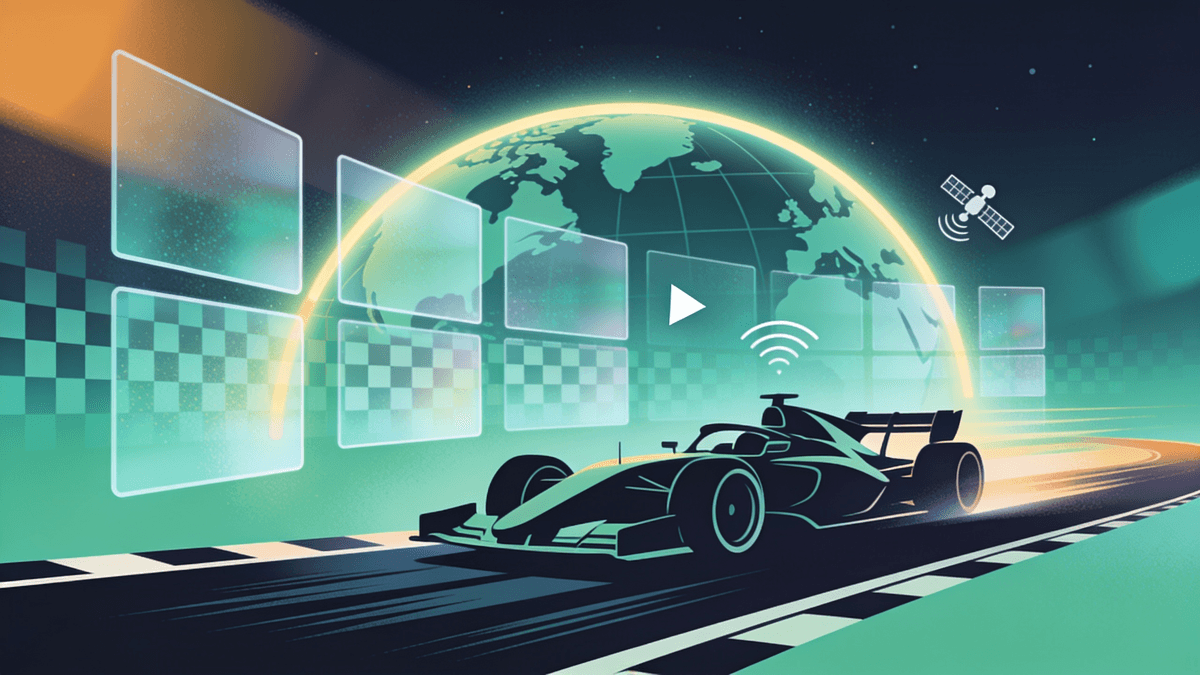
Formula 1's 2026 season now runs to 22 rounds after the Bahrain and Saudi Arabian Grands Prix were cancelled — and 14 are still to come, starting with Silverstone on 3–5 July. Sky Sports F1 holds the UK, Apple TV owns the US, and F1 TV Pro covers much of the rest of the world. Here is the verified guide.
The 2026 season at a glance
The 2026 campaign is the most disrupted — and most fascinating — Formula 1 season in a generation. A sweeping new rulebook has reshuffled the competitive order, two new manufacturers have arrived on the grid, and geopolitics removed two races from the calendar before the European summer even began. If you stopped paying attention in 2025, a lot has changed.
The season opened in Melbourne on 6–8 March and finishes at Abu Dhabi's Yas Marina Circuit on 4–6 December. The calendar was originally announced with 24 rounds, but the Bahrain and Saudi Arabian Grands Prix — scheduled for 10–12 April and 17–19 April — were called off over safety concerns tied to the escalating conflict in the Middle East. Formula 1 confirmed on 14 March that neither race could be replaced at such short notice, reducing the championship to 22 rounds and leaving an unusual five-week gap between Japan in late March and Miami at the start of May.
On track, the new regulations have produced a genuine shake-up. Mercedes has adapted best to the 2026 cars: after eight completed rounds, 19-year-old Kimi Antonelli leads the drivers' championship on 171 points, 40 clear of team-mate George Russell, who won the most recent race in Austria ahead of Max Verstappen — Russell's second victory of the season. Lewis Hamilton sits third on 125 points in his second Ferrari campaign, with the McLaren pair and Charles Leclerc bunched just behind and Verstappen only seventh. The grid has also grown to 11 teams and 22 drivers, with Cadillac entering as an all-new outfit and Audi taking over the former Sauber operation.
Off track, the viewing landscape has shifted just as dramatically. The United States lost ESPN and gained Apple TV as F1's exclusive broadcaster, Sky locked up the UK and Ireland until 2034 and Italy until 2032, and F1 TV — Formula 1's own streaming service — added a 4K Premium tier that is now priced and packaged differently in almost every country. Knowing exactly where to watch, and what it costs where you live, has never mattered more.
The verified 2026 calendar: what's already run and what's left
Eight rounds are in the books as of early July: Australia, China, Japan, Miami, Canada, Monaco, Spain (Barcelona-Catalunya) and Austria. That leaves 14 Grands Prix to watch between now and December, spread across Europe, Asia and the Americas — including a brand-new venue in Madrid and the now-traditional Las Vegas night race.
Here is every remaining round of the 2026 season, with dates confirmed against the official Formula 1 calendar:
- 1British Grand Prix — Silverstone, 3–5 July (Sprint weekend)
- 2Belgian Grand Prix — Spa-Francorchamps, 17–19 July
- 3Hungarian Grand Prix — Budapest, 24–26 July
- 4Dutch Grand Prix — Zandvoort, 21–23 August (Sprint weekend)
- 5Italian Grand Prix — Monza, 4–6 September
- 6Spanish Grand Prix (Madrid) — new Madring circuit, 11–13 September
- 7Azerbaijan Grand Prix — Baku, 24–26 September
- 8Singapore Grand Prix — Marina Bay, 9–11 October (Sprint weekend)
- 9United States Grand Prix — Austin, 23–25 October
- 10Mexico City Grand Prix — 30 October–1 November
- 11São Paulo Grand Prix — Interlagos, 6–8 November
- 12Las Vegas Grand Prix — 19–21 November
- 13Qatar Grand Prix — Lusail, 27–29 November
- 14Abu Dhabi Grand Prix — Yas Marina, 4–6 December
Three scheduling quirks worth circling
First, the summer break is longer than usual: after Hungary on 26 July, F1 doesn't race again until Zandvoort on 23 August — a gap of four full weeks. Second, Madrid's debut in September means Spain hosts two Grands Prix in 2026: Barcelona ran in June, and the new part-street, part-permanent Madring layout follows Monza in September. It's the first all-new European venue on the calendar in years, so expect enormous interest around that weekend.
Third, the season ends with a punishing run-in. Austin, Mexico City and São Paulo form one triple-header across late October and early November; then, after a single weekend off, Las Vegas, Qatar and Abu Dhabi run on three consecutive weekends from 19 November to 6 December, crossing twelve time zones in the process. If the title fight between the Mercedes drivers stays close, those three races could decide everything — and they are also the races most likely to strain streaming servers and start at awkward hours wherever you live.
Sprint weekends in 2026: the format explained
Six of the 22 race weekends run to the Sprint format in 2026, and three of them are still to come. China, Miami and Canada have already hosted theirs; Silverstone, Zandvoort in August and Singapore in October complete the set. Montreal, Zandvoort and Singapore are all first-time Sprint hosts this year, while Silverstone returns to the Sprint calendar for the first time since the format's 2021 debut.
The Sprint structure matters for viewers because there is meaningful track action on all three days — and only one practice session all weekend:
- Friday: a single one-hour free practice session, followed by Sprint Qualifying — a shortened three-part knockout (SQ1, SQ2, SQ3) that sets the grid for Saturday's Sprint. In dry conditions, new medium tyres are mandatory in SQ1 and SQ2, softs in SQ3.
- Saturday: the 100km Sprint race (roughly 30 minutes, no mandatory pit stops), followed later in the day by full Qualifying for the Grand Prix.
- Sunday: the Grand Prix itself, at full race distance.
Points in the Sprint go to the top eight finishers on an 8-7-6-5-4-3-2-1 scale, so a Sprint win is worth eight points on top of anything a driver scores in Sunday's Grand Prix. In a season this tight at the top, Sprint Saturdays are not optional viewing. If you only stream one extra session per Sprint weekend, make it the Sprint itself: at 30 minutes with minimal strategy variance, it's the purest head-to-head racing the modern calendar offers.
Broadcasters by country: who shows F1 in 2026
The biggest broadcast story of 2026 is the United States, where ESPN's eight-year run ended and Apple TV took over as the exclusive American home of Formula 1 — but almost every major market has its own gatekeeper. Here's the verified country-by-country picture, checked against Formula 1's official broadcast listings.
- United States — Apple TV. Apple signed an exclusive five-year deal reportedly worth around $150 million per season. Every practice, qualifying session, Sprint and Grand Prix streams on Apple TV ($12.99/month or $99.99/year), and Apple makes all practice sessions plus selected races available free in the Apple TV app. There is no cable option anymore: no ESPN, no ABC.
- United Kingdom & Ireland — Sky Sports F1, which carries every session of every weekend live and in May 2026 extended its exclusive deal through 2034. Channel 4 airs free extended highlights of every round and broadcasts the British Grand Prix live — so the Silverstone race is free-to-air in the UK.
- France — Canal+, the long-time premium home of F1, with every race live and full French commentary.
- Germany — Sky Deutschland carries the full live season, with RTL retaining a free-to-air presence — seven races air live on RTL in 2026.
- Italy — Sky Italia shows every session live under the renewal announced alongside the UK deal — running to 2032 in Italy — while TV8 keeps a small free-to-air selection of races and Sprints.
- Spain — DAZN holds exclusive live rights with a dedicated F1 channel — relevant twice over in 2026, with both Barcelona and the new Madrid race on home soil.
- Netherlands — Viaplay, which also covers Sweden, Norway, Denmark, Finland and Iceland through its streaming apps.
- Canada — RDS and TSN split French- and English-language coverage, with free-to-air coverage limited to the home Canadian Grand Prix on CTV and Noovo.
- Australia — Fox Sports via Foxtel, with streaming on Kayo Sports.
- Brazil — TV Globo and sportv. Globo airs a large slate of races free-to-air — up to 15 in 2026 — with every session live on pay channel sportv.
- Mexico — Sky Sports (Mexico) carries every session live, with the Mexico City Grand Prix free-to-air on Canal 5.
- India — FanCode, which streams every session of every weekend live.
- Japan — Fuji TV, F1's longest-standing national broadcaster: every session runs live on the Fuji TV Next pay channel, with highlights on the main network.
Two practical takeaways. First, free-to-air F1 still exists in 2026, but it's fragmentary: Channel 4's British GP coverage and highlights in the UK, RTL's seven live races in Germany, Globo in Brazil, and Apple's free practice sessions in the US. Second, if you travel across any of these borders mid-season, your home subscription typically stops working the moment the service sees a foreign IP address — a problem we cover in detail in our guide to the best VPNs for sports streaming.
F1 TV Pro and Premium: availability and why pricing differs so much
F1 TV is Formula 1's own streaming service, and in most of the world it's the single best way to watch: every session live, onboard cameras for every driver, team radio, live timing and full replays. But it is deliberately not available everywhere — and where it is available, the price varies enormously from country to country.
The service comes in three tiers:
- F1 TV Access — replays, highlights and live timing, but no live sessions. This is the entry tier sold in most countries.
- F1 TV Pro — everything live: practice, qualifying, Sprints and races, plus all onboard cameras and team radio.
- F1 TV Premium — Pro plus 4K Ultra HD/HDR, customisable multiview and extra features. Introduced in March 2025 as the top tier.
Availability is dictated by Formula 1's exclusive national broadcast deals. In the United Kingdom, F1 TV cannot show live sessions at all — Sky's exclusivity, now locked in until 2034, blocks the Pro and Premium tiers, leaving UK fans with the Access tier (£2.29/month or £19.99/year) for replays, highlights and live timing. In France, Canal+'s exclusivity means F1 TV's live tiers are closed to new subscribers. And in the United States, F1 TV Premium is no longer sold separately: from 2026 it's included with an Apple TV subscription, which at $99.99/year is actually cheaper than the $129.99 Americans paid for Premium standalone in 2025.
Where Pro and Premium are sold, the price gaps are striking. Comparison data covering more than 120 countries shows the Access tier alone ranging from $1.70/month in the cheapest market (Guadeloupe) to about $4.55/month in the most expensive (the Czech Republic) — a spread of more than 160% for an identical product. The live tiers diverge even harder: F1 TV Pro costs €11.90/month in the Netherlands, while a full year of Pro costs $29.99 in India and $39.99 in Brazil — less than four months of the Dutch subscription. Formula 1 prices each market against local purchasing power and, crucially, against whatever exclusive TV deal it has already sold there: where a broadcaster paid heavily for exclusivity, F1 TV is either restricted or priced high so it doesn't cannibalise the partner's subscribers.
Which tier do you actually need?
If you watch only the Grands Prix and don't care about onboards, your national broadcaster or Access-tier replays may be enough. If you follow every session, Pro is the sweet spot where it's sold. Premium's 4K and multiview only pay off on a large screen with fast broadband — and in the US the question is moot, since Apple TV includes the Premium feature set. If regional price discrimination interests you, it isn't unique to F1: we track the same phenomenon across VPN subscriptions in our live VPN Price Index, and the underlying logic — identical product, wildly different regional price tags — is the same.
Where a VPN fits in
A VPN routes your connection through a server in another country, which matters to F1 fans in two specific situations: keeping your paid-for home coverage while you travel, and reaching your F1 TV account from regions where it's normally restricted. It is not a magic wand, and it comes with fine print you should understand before relying on it for lights-out.
The most defensible use case is travel. If you pay for Sky Sports F1, Canal+ or Viaplay and fly abroad for two weeks in August, your stream will typically be blocked the moment the service detects a foreign IP address. Connecting to a VPN server in your home country restores the connection you already pay for — you land in Lisbon, connect to a London server, and your Sky or NOW login works as if you never left. The same applies to F1 TV Pro subscribers whose accounts are tied to a home region.
A few honest caveats before you rely on this for a race weekend:
- Streaming services' terms of service generally prohibit circumventing geographic restrictions, and platforms like F1 TV actively detect and block known VPN IP ranges. A server that works today may need swapping tomorrow.
- Signing up for F1 TV in a cheaper country usually requires a payment method from that region, not just an IP address — the price arbitrage is harder in practice than VPN marketing implies.
- Live 4K sport is unforgiving of slow connections. Before a race weekend, verify your VPN's real throughput with a proper VPN speed test — you want at least 25 Mbps of headroom for Premium-tier 4K streams.
- Make sure your provider passes leak tests: a DNS leak can reveal your true location to a streaming service even while the VPN is connected.
For live sport specifically, prioritise VPNs with large server fleets in the countries you care about, consistently high speeds at peak hours, and a track record of staying ahead of streaming blocks — the criteria we weight heavily in our sports streaming VPN rankings. And if you're unsure whether a specific session is even available where you're sitting, our Can I Watch tool answers that in a few clicks.
ExpressVPN is our top-tested pick for live F1: fast enough for 4K, reliable with Sky Sports, F1 TV and Viaplay in our latest checks, and easy to run on a TV or router.
See our top-ranked VPNs →The 2026 rules revolution: why this season looks so different
Even if you only watch casually, 2026 is worth following because the cars themselves are radically new. This is the biggest simultaneous chassis-and-engine regulation change in Formula 1's modern history, and it explains both Mercedes' resurgence and the general unpredictability of the first eight rounds.
- 50/50 hybrid power. The 1.6-litre turbocharged V6 stays, but the complex MGU-H is gone and electrical output roughly triples from 120kW to 350kW — meaning close to half the car's total power now comes from the battery. Energy management has become as decisive as raw pace.
- 100% sustainable fuel. Every engine runs on Advanced Sustainable Fuels made from sources such as carbon capture, municipal waste and non-food biomass — a first for the championship.
- Active aerodynamics replace DRS. Both front and rear wings now physically change angle around the lap: a low-drag straight-line mode and a high-downforce cornering mode. The old DRS overtaking flap is gone.
- Manual Override. In DRS's place, a driver within one second of a rival gets a temporary burst of extra electrical deployment — a push-to-pass-style boost designed to keep overtaking alive.
- Smaller, lighter cars. The maximum wheelbase shrinks by 200mm to 3.4 metres, overall width drops by 100mm to 1.9 metres with the floor around 150mm narrower, minimum weight falls by roughly 30kg, and Pirelli's tyres are narrower by 25mm at the front and 30mm at the rear.
- A bigger grid. Cadillac joins as the sport's 11th team, and Audi has turned Sauber into its factory outfit — two genuinely new manufacturer commitments arriving in the same season.
The competitive consequence has been a reset. Teams that dominated the ground-effect era have had to start over on energy deployment, active-aero calibration and ride characteristics, and the early 2026 pecking order — Mercedes ahead, a chasing Verstappen, and a teenager leading the championship — reflects exactly that. Historically, regulation-change seasons produce the largest in-season development swings, so the team that's quickest in July is not guaranteed to be quickest in Abu Dhabi. That's one more reason not to skip the second half of this calendar.
Practical tips for following the rest of the season
With 14 rounds, three Sprint weekends and a live title fight, a bit of planning saves real money and real frustration. These are the tactics we'd actually use, whichever country you're watching from — and most of them take five minutes to set up before the next race weekend.
- Anchor your calendar around the time zones. The remaining European rounds (Silverstone through Madrid) race on Sunday afternoons European time; Singapore is a night race that suits European evenings; the Americas swing — Austin, Mexico City, São Paulo, Las Vegas — pushes start times late into the European night, with Las Vegas famously running Saturday night local time.
- In the US, do the maths on Apple TV. The $99.99 annual plan works out cheaper than $12.99 a month once you'd subscribe for eight months or more — and every practice session streams free in the Apple TV app, no subscription needed.
- In the UK, don't pay for the British Grand Prix. Channel 4 has it live and free. For the rest of the season, Sky Sports F1 or a NOW streaming pass are the only live routes.
- Get it on the big screen properly. F1 TV, Apple TV, Sky, DAZN and Viaplay all ship native apps for major TV platforms, and pairing them with a VPN works best either on an Android TV setup or by running the VPN on your router so every device in the house benefits.
- Prepare for the finale early. Las Vegas, Qatar and Abu Dhabi run on three consecutive weekends. If the championship goes to the wire, expect those to be the most VPN-blocked, most congested streams of the year — test your setup the week before, not five minutes before lights out.
However you watch, the second half of 2026 has everything a neutral could ask for: a teenage championship leader, a brand-new Madrid race, three Sprint weekends, and a rulebook that's still producing surprises race by race. Fourteen races remain. Pick your broadcaster, sort your setup, and don't miss lights out on Sunday at Silverstone.
Frequently asked questions
How many F1 races are left in the 2026 season?
Fourteen of the 22 rounds remain as of early July 2026, beginning with the British Grand Prix at Silverstone on 3–5 July and ending with the Abu Dhabi Grand Prix on 4–6 December. The run includes three Sprint weekends (Silverstone, Zandvoort, Singapore) and the brand-new Madrid Grand Prix in September.
Why were the Bahrain and Saudi Arabian Grands Prix cancelled?
Formula 1 confirmed on 14 March 2026 that both April races were called off over safety concerns linked to the escalating conflict in the Middle East, with both countries hit by strikes amid the wider regional escalation. With the calendar already packed, neither race could be replaced, so the season was reduced from 24 to 22 rounds.
Is Formula 1 still on ESPN in the United States?
No. ESPN's contract ended after 2025, and Apple TV is now the exclusive US broadcaster under a five-year deal. Every session streams on Apple TV at $12.99/month or $99.99/year, with all practice sessions and selected races free in the Apple TV app. F1 TV Premium features, including 4K and multiview, are included with an Apple TV subscription.
Can I get F1 TV Pro in the UK?
No — live F1 TV tiers are blocked in the UK because Sky Sports holds exclusive live rights, a deal extended in May 2026 through 2034. UK fans can only use F1 TV's Access tier (replays, highlights and live timing). Live options are Sky Sports F1, a NOW streaming pass, or Channel 4's free live coverage of the British Grand Prix.
Which 2026 races use the Sprint format?
Six rounds: China, Miami, Canada, Great Britain (Silverstone), the Netherlands (Zandvoort) and Singapore. Sprint weekends feature one practice session and Sprint Qualifying on Friday, the 100km Sprint plus full Qualifying on Saturday, and the Grand Prix on Sunday. The top eight Sprint finishers score points on an 8-7-6-5-4-3-2-1 scale.
Is it legal to use a VPN to watch F1?
Using a VPN is legal in most countries. However, streaming services' terms of service typically prohibit bypassing geographic restrictions, and platforms like F1 TV actively block known VPN IP addresses, so access can break without notice. The most defensible use is reconnecting to a service you already pay for while travelling abroad.
Why does F1 TV cost different amounts in different countries?
Formula 1 prices F1 TV against each market's purchasing power and its existing national TV deals. Where a broadcaster has paid for exclusivity — like Sky in the UK or Canal+ in France — F1 TV's live tiers are restricted or withheld entirely. Elsewhere, a year of F1 TV Pro runs from $29.99 in India and $39.99 in Brazil to several times that in parts of Europe.
The best VPNs of 2026, ranked
Now you know how — here are the VPNs we recommend, independently tested and ranked for speed, streaming, privacy and value. Any of them works for everything in this guide.

ExpressVPN Ultra fast & secure. Great for privacy, downloads, and everyday browsing on all your devices. 24/7 live chat support.
ExpressVPN Ultra fast & secure. Great for privacy, downloads, and everyday browsing on all your devices. 24/7 live chat support.
IPVanish Fast speeds with unlimited device connections. Strong no-logs privacy and 24/7 live chat support. Great for families.
IPVanish Fast speeds with unlimited device connections. Strong no-logs privacy and 24/7 live chat support. Great for families.

NordVPN Excellent speeds with one of the largest server networks. Strong security features and easy-to-use apps. 24/7 live chat support.
NordVPN Excellent speeds with one of the largest server networks. Strong security features and easy-to-use apps. 24/7 live chat support.

Proton VPN Swiss-based VPN with strong privacy focus. Audited no-logs policy and open-source apps. Great for privacy-conscious users.
Proton VPN Swiss-based VPN with strong privacy focus. Audited no-logs policy and open-source apps. Great for privacy-conscious users.

CyberGhost Fast speeds and strong privacy tools. Simple apps, automatic WiFi protection, and 24/7 live chat support.
CyberGhost Fast speeds and strong privacy tools. Simple apps, automatic WiFi protection, and 24/7 live chat support.

TotalVPN Affordable VPN with strong privacy and reliable speeds. Easy-to-use apps for all major devices. No-logs policy.
TotalVPN Affordable VPN with strong privacy and reliable speeds. Easy-to-use apps for all major devices. No-logs policy.

Private Internet Access High-speed VPN with a large server network and advanced security settings. Ad blocker included and 24/7 live chat support.
Private Internet Access High-speed VPN with a large server network and advanced security settings. Ad blocker included and 24/7 live chat support.

Surfshark Unlimited device connections at a budget-friendly price. Includes ad blocker and strong privacy tools. Great value for money.
Surfshark Unlimited device connections at a budget-friendly price. Includes ad blocker and strong privacy tools. Great value for money.
Rankings are based on our independent testing methodology. We evaluate speed, privacy, security features, and value for money. We may earn affiliate commissions from links on this page, which helps fund our testing — this does not influence our rankings.